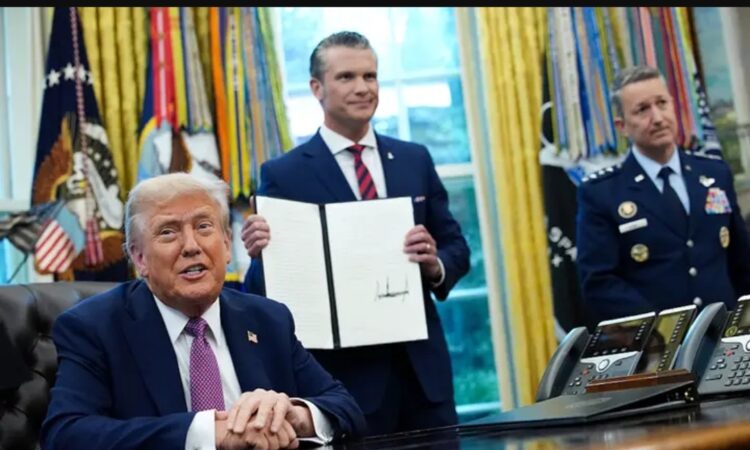
President Donald Trump has followed through on one of his campaign promises, but in a way that reveals more about his personal style and priorities than about genuine national security. On September 5, 2025, he signed an executive order renaming the Department of Defense the Department of War, reviving the old name that was abandoned in 1949.
He justified the change by saying America was once strong and victorious in past wars, but had gone “woke” when it switched to the Department of Defense. In Trump’s view, calling it the War Department sends a tougher, clearer signal to the world about American strength.
Trump campaigned in 2024 on the idea that he would end “stupid endless wars” and usher in what he called a new golden age of peace under American leadership. He suggested there would be stability in Ukraine and the Middle East, and that no rival power would dare challenge the United States. He even fantasized about winning the Nobel Peace Prize for his achievements.
But none of those promises have come true. Instead, his foreign policy has been erratic and unpredictable, more like a performance for television than careful statecraft. Strongmen like Russia’s Vladimir Putin have learned that flattering Trump can influence him, even when it means harming America’s own interests.
At the heart of this decision is Trump’s fascination with power, punishment, and violence. As commentators have noted, he often uses violent language and imagery when talking about politics, and his new “War Department” fits that pattern. Standing beside him in the Oval Office, Secretary Pete Hegseth celebrated the rebrand, declaring that the U.S. military would now go “on offense, not just defense,” emphasizing maximum force over restraint, and warriors over defenders. Hegseth even started calling himself the “Secretary of War,” clearly thrilled by the new title.
Critics, however, see this move as a stunt that reveals deeper problems. Conservative columnist Max Boot described the renaming as typical of Trump—flashy, headline-grabbing, and legally questionable. After all, Congress is the branch of government with the power to create or dismantle federal departments, not the president. But Trump and his allies have brushed aside such limits before, and they are doing it again here.
By framing the old Defense Department as “woke,” Trump and Hegseth also tapped into the culture-war rhetoric central to MAGA politics. For them, “woke” is shorthand for weakness, inferiority, and being un-American. It is often used to attack women, racial minorities, LGBTQ people, and anyone who doesn’t fit their vision of a “real American”—white, straight, Christian men. This ideology has shaped personnel decisions within the military. Senior Black, brown, and female leaders have been sidelined or purged, LGBTQ troops—especially transgender service members—are being forced out, and diversity programs have been dismantled. Public celebrations like Black History Month and Women’s History Month are now banned in military spaces. Hegseth summed up his approach bluntly earlier this year when he said, “The single dumbest phrase in military history is ‘our diversity is our strength.’”
Civil rights leaders warn that this campaign is dangerous. Maya Wiley of the Leadership Conference on Civil and Human Rights has called out Trump’s attempts to purge military lawyers and officers he sees as insufficiently loyal. She pointed to Trump’s own comments that he wanted generals like those who served Adolf Hitler—a chilling reminder of what kind of loyalty he values. For years, Trump has hinted that he wants a military elite that answers to him personally rather than to the Constitution, and his actions are now making that vision a reality.
There is a long tradition in America of the military serving as one of the few institutions where Black and brown people could rise to positions of authority, sometimes even commanding white officers. Trump’s project seeks to unravel that tradition. Since his inauguration, archives highlighting the contributions of women, minorities, and LGBTQ service members have been scrubbed from government websites, and military bases or ships named after them have been renamed.
The irony is that Trump owes much of his political success to white working-class men, many of whom come from rural areas and the Rust Belt, and whose families have historically borne the brunt of U.S. military deaths in foreign wars. His push for a War Department, along with his increasingly aggressive foreign policy, ultimately betrays the very people who helped put him in power. Critics like Tom Nichols have noted that this move insults the sacrifices of those who died in conflicts like Korea and Vietnam, which Trump dismisses as wars America didn’t “win” because it was supposedly too soft or too “woke.” This echoes his past comments disparaging American soldiers who were captured or killed as “suckers” and “losers.”
The renaming of the Defense Department should be seen not only as political theater but also as part of a broader shift in how Trump views the military. His choices show that he wants a force defined by aggression and loyalty to him rather than to democratic values or the rule of law. For his loyal voters, especially working-class whites who send their sons and daughters to serve, this should be a wake-up call. Wars are rarely fought by wealthy elites; they are fought by the young and poor, who pay with their lives while others profit. Nearly a century ago, Marine Corps hero Maj. Gen. Smedley Butler wrote *War is a Racket*, where he warned that wars enrich the powerful but cost ordinary people everything. His words remain true today, and Trump’s War Department only underscores that reality.