A scientist has warned that something strange might happen soon, describing it as a possible “black swan event” — a rare and unpredictable occurrence with potentially huge consequences. The concern comes after the discovery of a mysterious object heading toward Earth’s part of the solar system.
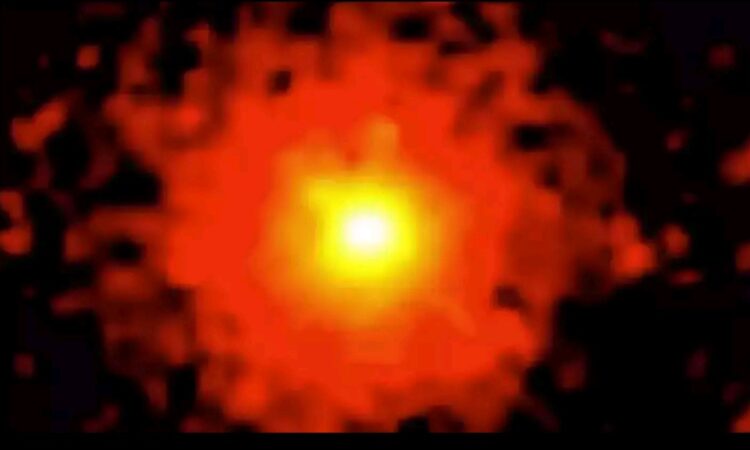
The object, known as 3I/ATLAS, was spotted by NASA on July 1 using the Asteroid Terrestrial-impact Last Alert System (ATLAS). It’s a comet roughly the size of New York City, and it’s only the third known interstellar object — something that came from outside our solar system — ever recorded.
What’s making scientists uneasy is that no one knows where this comet came from. Some researchers believe it may not be a normal space rock at all. Harvard astrophysicist Avi Loeb and his team have even suggested that there’s a 30–40% chance it could be an artificial object — possibly created by intelligent beings from another world.
Loeb pointed out that new images of the comet seem to show signs of “braking thrust,” meaning it could be slowing down intentionally as it moves through space. In a paper written with two other Harvard researchers, Loeb explained that if this comet is a technological object, it could be controlled by intelligent life. He added that there are only two possibilities if that’s true — either its purpose is peaceful, or it’s hostile.
Still, scientists say there’s no need to panic. The comet isn’t expected to collide with Earth. It will reach its closest point to the Sun around October 30 before continuing its path. Loeb jokingly said that people might want to “take a vacation” before that date, just in case something unusual happens.
The term “black swan event” refers to something rare and unpredictable that has a major effect — like an unexpected event in space that goes against everything we’ve seen before. Loeb believes that while the odds are small, the comet could behave in ways that surprise us.
This isn’t the first time scientists have questioned whether a space object could be alien. In 2017, another interstellar visitor called ‘Oumuamua caught attention because it looked like a long, thin craft and appeared to be pushed by sunlight. Some experts thought it might be artificial, though others disagreed and said there was no proof. Similarly, there’s currently no solid evidence that 3I/ATLAS is doing anything out of the ordinary.
Right now, the comet is behind the Sun, which makes it too bright for telescopes to see. Astronomers expect to get another look at it on November 2, when the European Space Agency’s JUICE spacecraft observes it while heading toward Jupiter. By early December, the comet should reappear on the other side of the Sun.
Loeb suggested that October 30 — the comet’s closest pass to the Sun — could be a key moment for observation. He mentioned something called the “Oberth effect,” which is a principle in physics that says spacecraft can burn fuel more efficiently when they are moving at higher speeds. If the comet were actually a spacecraft, it could use this effect to move faster or change direction.
In simple terms, while some theories about 3I/ATLAS sound like science fiction, most scientists agree it’s probably just a regular comet passing through. Still, it’s one worth watching closely — not because Earth is in danger, but because it reminds us how much we still have to learn about what’s out there in the vastness of space.